
In the early 2010s a polyamory fad swept through my social scene like crack through a black ghetto. No marriage or long-term relationship that dabbled in ethical-non-monogamy survived the decade. Many didn’t survive the year. The relationships opened up, then fell apart. Children of these couples were made to adapt to a rotating cast of new partners coming in and out of their lives, to mom or dad being absent with lovers on evenings or weekends, and then finally to parents who didn’t live together anymore. It spread from couple to couple like the STDs they would have been swapping if this were the 70s, or if they were poor. But these were upper-middle-class, white, college-educated couples, people who ought to have known better. They didn’t.
My peers were responsible. They were liberated, enlightened, modern. Untouchable by something as trivial, as low-class, as base sexual jealousy. They were careful, prioritized open communication and diligent rule-following. Nobody got HIV, there were no accidental bastards. And they still got split down the middle. The unraveling of their marriages came as a shock to them, and then it was too late to undo.
I can trace the chaos of those years to the rise of a single book, 2010’s Sex at Dawn.
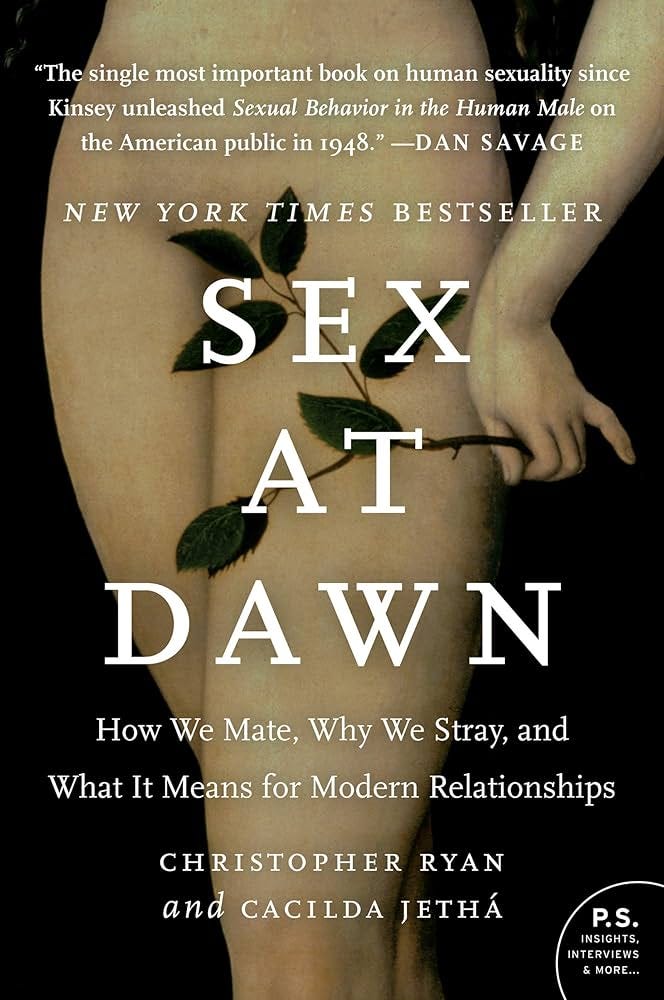
Using evidence from evolutionary psychology and anthropology, Sex at Dawn argues that monogamy is, if not strictly unnatural, then at least a very modern innovation that goes against our instinctive drives and inclinations, a mismatch with the way our distant ancestors lived and loved1. Through the book’s lens, infidelity is the inevitable outcome of impossible expectations we unfairly place on each other. Monogamy might have benefits, but for many people it is either an unrealistic demand or an unacceptable imposition on their happiness and self-expression.
To say that this book was fêted by the respectable print establishment would probably be an overstatement. But it was well received among the bien-pensant, including the half-dozen or so of my peers who read it and wanted to tell me all about it. Dan Savage, America’s leading sex columnist, called it “the single most important book on human sexuality” published in sixty years. The Times gave it a respectful nod in an article titled Married, With Infidelities, where they quote Savage’s endorsement of non-monogamy.
Savage has for 20 years been saying monogamy is harder than we admit and articulating a sexual ethic that he thinks honors the reality, rather than the romantic ideal, of marriage. In Savage Love, his weekly column, he inveighs against the American obsession with strict fidelity. In its place he proposes a sensibility that we might call American Gay Male, after that community’s tolerance for pornography, fetishes and a variety of partnered arrangements, from strict monogamy to wide openness.
There’s that magic word: tolerance. A certain kind of educated urban liberal will agree to nearly any proposition if you can convince them it’s the tolerant thing to believe. Their memetic immune system has been crippled by a pathological need to avoid judging even destructive choices, so harmful ideas can easily take root in their minds, like an AIDS patient who succumbs to a fungal spore that usually only infects eucalyptus2. And who says open relationships are harmful anyway? As long as everyone is consenting, what’s the big deal?
The big deal is that this shit is contagious. In the same way that having a close friend get divorced nearly doubles your own odds of splitting up, having poly friends makes you more likely to dip your toe in the lifestyle. In my own social group it started with a single woman. Whether she and her husband had an inclination to open up their marriage before they read Sex at Dawn I can’t say. All I know is that the same year they couldn’t shut up about the book she started arriving at our parties with her new boyfriend (who was this guy, and did her husband know? our other friends demanded in whispered asides). A year after that there was a handful of couples openly practicing non-monogamy of some flavor. A year again later, the divorces and breakups starting rolling in, and they haven’t ever really stopped.
At the time we were as guilty as any of them of failing the fundamental test of judgment, of declining to condemn reckless behavior with respect to one’s most important relationship. Who were we to judge, after all? And were we the smallest bit titillated and enthralled by the spectacle of it all? Didn’t we feel worldly being friends with members of an up-and-coming romantic avant-garde? Certainly we did, just as we could see the obvious appeal. Even as we demurred that it wasn’t for us personally, the arguments about personal liberty and stories about the benefits of “new relationship energy” made sense to us, jived with our self-conception as tolerant free thinkers. And in any case, what were we to do, jettison a growing subset of our social group for offenses — against whom, exactly? Not us, or so we thought at the time. It wasn’t our business.
But of course that’s total nonsense, and dangerous nonsense at that. The norms around sex and relationships adopted by one’s peers are of supreme importance to one’s own life. They form the social background against which our own choices will be judged, to be found virtuous or lacking. They inform the expectations any new romantic interest brings to the table, the things they feel comfortable calling a deal-breaker or starting a fight over, what’s in bounds or off the table. And they contribute to our sense of social stability and harmony or lack thereof. I witnessed my peers tolerate the sort of drama and interpersonal chaos in their friend groups that you would more commonly see among, well, not upper-middle-class white college-educated professionals. And I watched them make excuses for it. I even fell into this trap myself, for a time.
Yes, these thoughts are spurred by Lindy West’s newest memoir. You thought you could escape, but no. It’s 9/11 for proudly fat girls who shouted their abortions, and it’s all anyone can talk about — particularly West’s extremely reluctant acceptance of her husband’s polyamory. But what I found very interesting is that every one of the several West post-mortem articles I read began with throat-clearing about how polyamory per se isn’t the problem here; it’s a respectable lifestyle choice that works well for lots of people, we promise! (You don’t know them, they go to another school). The real problem is that West’s husband’s behavior was non-ethical non-monogamy, supposedly because she wasn’t given a truly free and informed choice in the matter, or because she didn’t agree upon detailed rules he assiduously followed, or because he didn’t tell her about all of his dalliances before embarking on them.
It’s easy for me to believe her husband is a man of low character, maybe even an abusive asshole. But I find it absurd that his offenses are supposed to take on a completely different moral tenor on the basis of whether he said the proper incantations, filled out the right forms, before their commission. The man stepped out on his wife with multiple other women and then put her through the humiliation ritual of posing with his much more attractive new partner for media spreads. Are we so unmoored from basic morality that we have to hem and haw about whether his permission slip was signed with the right color ink?
Criticizing West and her husband for “doing poly wrong” misses the point, which is that polyamorous relationships are by their nature prone to drama, conflict, and violent failure. They are volatile, unstable, and this can’t be wished away or tamed by rules. Yes, there are successful long-term polyamorous couples. But for every one such unicorn there are dozens of open relationships badly floundering in interpersonal misery, marriages opening up to spill their guts onto the ground and die. Even when everyone is following all the rules and best practices, being open and communicative and self-aware, opening a relationship is extreme risk-taking behavior like doing hard drugs or riding a motorcycle drunk with no helmet. Something could easily, foreseeably go wrong and you could get hurt. You may as well criticize someone for “doing crystal meth wrong.” Was their technique really the problem?
These days I break from the typical liberal attitude of “none of my business.” Poly relationships predictably hurt people, including innocent bystanders and children, and we shouldn’t condone them. Broad tolerance of the lifestyle provides normative cover for men like West’s husband to demand some action on the side from their reluctant wives and girlfriends under the auspices of enlightened progressive values. His ultimatum about his poly desires, delivered to his sobbing future wife, didn’t take place in a vacuum, to be judged on its merits from first principles. Rather, it took place against the backdrop of over twenty years of activism by Savage and his allies to paint polyamory as a perfectly valid lifestyle choice, something a person should feel unashamed to request from a partner. Dan Savage walked so Aham Oluo could run. Down the street, to sleep with his attractive neighbor behind his wife’s back.
What’s missing from all these conversations about fidelity is a simple question: what is the purpose of monogamy in marriage, and why was it considered the Western ideal for thousands of years, even as we acknowledged that we frequently failed to live up to it? For that matter, what is marriage for? The liberal values of personal liberty and individual fulfillment from which polyamory derives its philosophical justification are directly at odds with the institution, which insists that we do not belong entirely to ourselves, but to our husbands and wives, as they belong to us. That our individual freedom and happiness is no longer our highest priority, that we have obligations to something larger that must come first.
Marriage constrains and limits our behavior by purposeful design. But those limits are beautiful. And more than beautiful, they are grounding. Paradoxically, marriage is freeing in the way of all permanent and unalterable decisions: this is my wife, for better or worse (in sickness and in health). There is no plan B, no backup person to turn to. I know what I must do: I have to make this work because the very foundation of my life depends on it. To introduce a plan B is to undermine what makes marriage function, the central promise to forswear all others, for all time.
You shouldn’t gamble with stakes that high, and with such terrible odds. You won’t be one of the lucky ones. It won’t work for you.
At least, this is what I gather from third-party sources. Unlike many of my peers from back then, I haven’t read it and don’t intend to. It’s what the kids call an infohazard.
I stole this line from a professor of anthropology that I sometimes trade bon mots with on twitter
Arrested Development said it best:
Tobias: You know, Lindsay, as a therapist, I have advised... a number of couples to explore an open relationship where the couple remains emotionally committed but free to explore extramarital encounters.
Lindsay: Well, did it work for those people?
Tobias: No, it never does. I mean, these people somehow delude themselves into thinking it might, but... but it might work for us.
It's insane that anyone would take the argument that polyamory is good because that's how we lived in the ancestral environment seriously.
Common features of the ancestral environment: hookworms, intertribal warfare, infant mortality, rape.
Uncommon features of the ancestral environment: complicated spreadsheets where you resolve with your metamour who gets to bone Josh on Thursdays.