
It’s that wonderful time of year in the northern latitudes when we have all the daylight we could possibly want and more. We are embarrassed for riches, so much so that we sacrifice an hour of daylight in the morning when no one is awake and tack it onto the evening so that we can stay out later enjoying ourselves in the nice weather. Daylight savings time is a wonderful and distinctly American tradition, now adopted, like all our best cultural exports, by nearly every western country.
But like every good innovation, it has always attracted its share of noisy malcontents. For my entire adult life people have been complaining about the unbearable burden of changing their clocks twice a year. Decades ago the proposal from the stop-messing-with-the-clocks crowd was to stay on standard time year round, like Arizona and Hawaii already do — every state has the option to do so under the Uniform Time Act of 1966. But today’s clock carpers have converged on a proposal to make daylight savings time year-round, to move the clocks forward one final time and leave them there forevermore. To date, 19 states have passed legislation to so do, but none of these laws can go into effect until Congress amends the 1966 act. Now Trump has signaled his readiness to do so, to put the entire nation on permanent DST with the resurrection of the Sunshine Protection Act.
It should go without saying that this is a terrible idea, but apparently it does need to be said. Year-round daylight savings time doesn’t work. DST only makes sense in the summer months when there is abundant daylight to take advantage of. In the winter, setting the clock an hour ahead of solar time means the sun comes up way too late, making most people commute to school and work in the dark. Permanent DST polls well with the public because people are familiar with early sunsets but not with late sunrises, and they aren’t smart enough to realize you have to pick one. They don’t actually like DST; they like summer. Setting the clocks forward all year long doesn’t give you an endless summer, just miserably dark winter mornings. People haven’t thought it through and would hate it in practice.
We know this is the case because we already tried it. In the 1970s the entire US went on year-round DST in response to the energy crisis. People immediately turned on the program and it was repealed in less than a year.
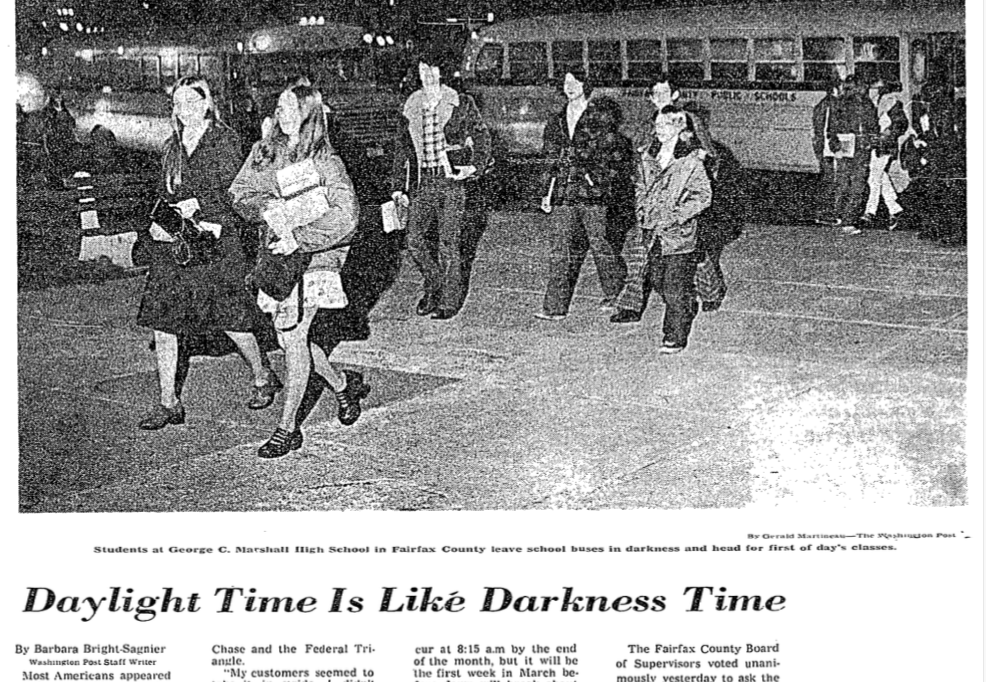
While 79 percent of Americans approved of the change in December 1973, approval had dropped to 42 percent three months later, the New York Times reported.
If we made DST year-round, most of the country would see the sun rise after 8 a.m. on the winter solstice.
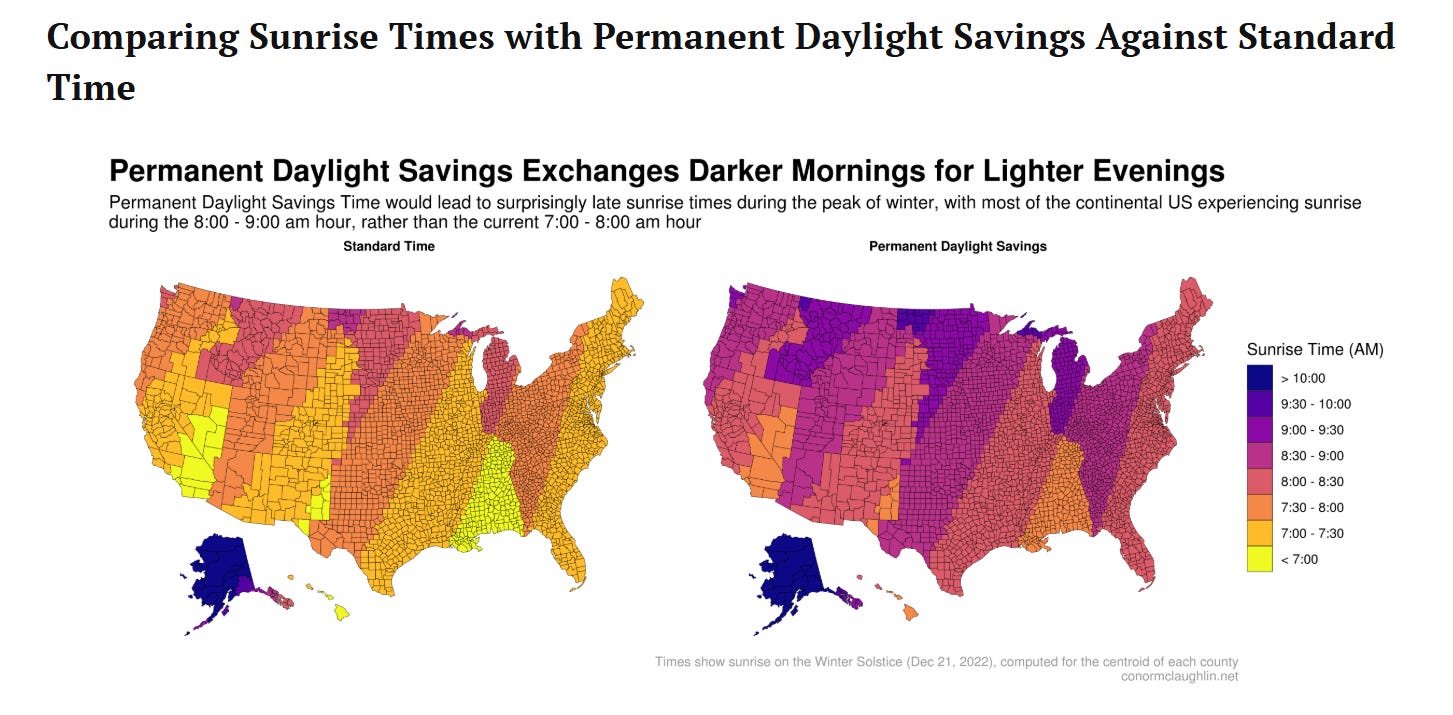
Some unlucky counties wouldn’t see the sun until around 10 am. And what would we get in exchange for this depressing morning state of affairs? The sun would set for most of us around 5:30 instead of 4:30. I can’t wait to break out the grill and enjoy that lovely 5:30 December sunshine in the back yard.
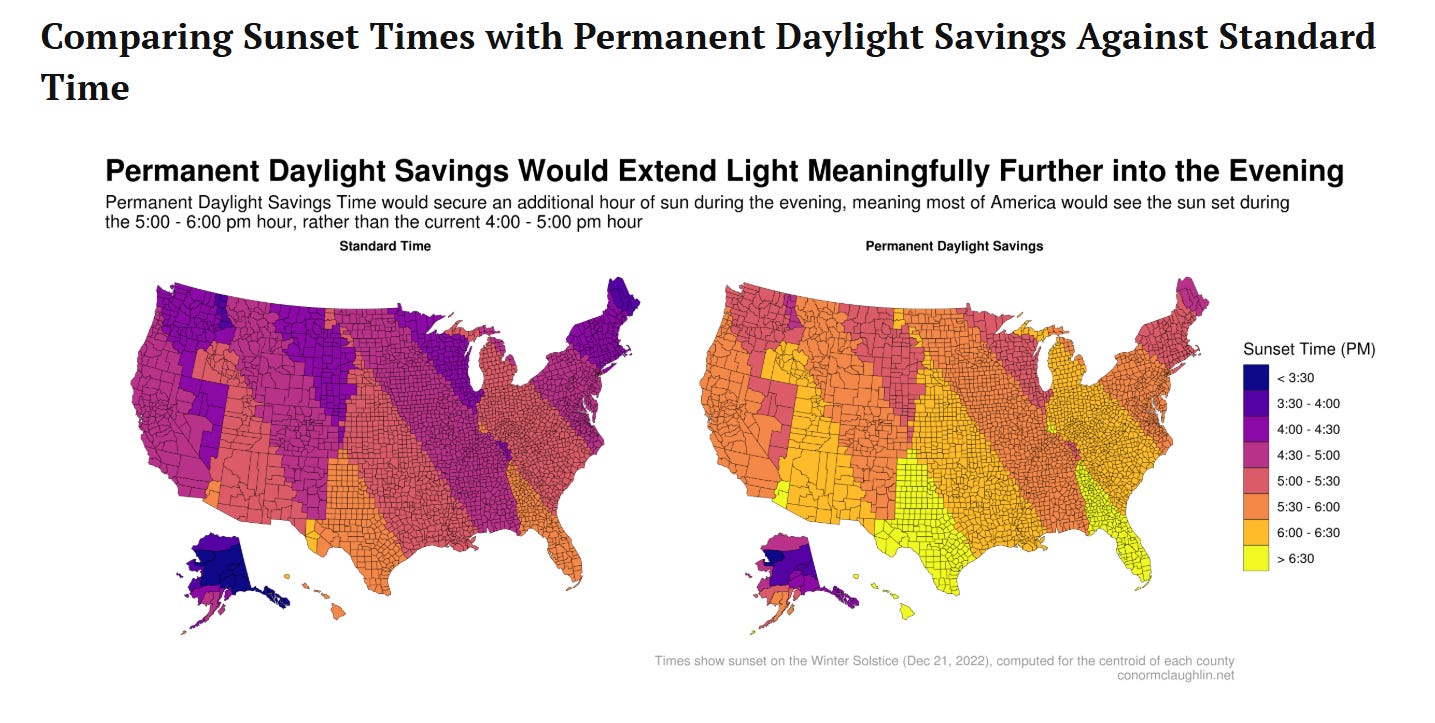
This is a bad trade. We won’t like it when it arrives. But because people know they don’t like early sunsets they endorse it, not realizing that a trade for late sunrises is even required.
In any case, what exactly are the arguments against getting rid of the time change in the first place? I know that people complain about having to manually adjust clocks, but surely I’m not the only one who’s noticed that all the most important clocks in our lives are now self-adjusting. How many non-self-adjusting clocks do you have in your home in 2026? (I have two, the microwave and one hanging on a wall). Adjusting them is the work of moments, and we do it twice a year. This is not the kind of inconvenience that should steer national policy.
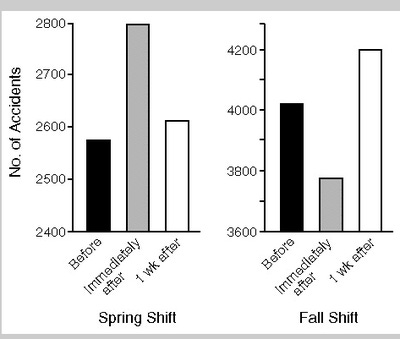
Technocratic wonks at outlets like Vox like to point out other externalities, like the increase in traffic accidents from everyone getting an hour less sleep. Accidents (not deaths) rise all of 8% on the Monday following the spring clock change. But they fall by a similar amount after the fall change, so it evens out.
Granted, there is one major real downside: kids keep waking up at their accustomed time for several days following a clock change, which is very irritating for parents of young kids in the fall. Everybody else gets that extra hour of sleep plucked from thin air, but not you, your little angels are going to stir at the same time their body always wakes them up. You can’t convince a 4 year old to go back to sleep for another hour like the clock says, you’re getting up with him.
But those times are fleeting, and the value we get from the clock adjustment is well worth this small cost. Getting to enjoy daylight at close to 10 p.m. in the summer instead of at 4 a.m. is great — but only if I can still have some daylight in the winter before 8, when I need to get the kids to school. That’s the wonderful deal that DST offers us, and we’d be fools to mess with it.
And the farther north you go, the better a deal it is, because there’s a much greater difference in seasonal light levels. Don’t tell Harvard graduates, but this is a simple consequence of the geometry of the earth’s tilted axis as it revolves around the sun. As a result, northern cities have much more to gain or lose from sensible clock management than those on the southern border. Here’s a chart I found on Reddit of hypothetical daylight hours under different time systems for Seattle, the northernmost major city in the continental US.
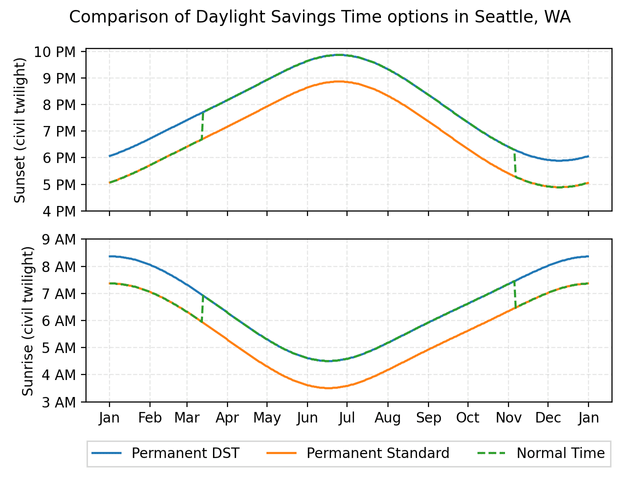
Without DST, Seattle has to pick between dawn at 3:30 a.m. in the summer or 8:30 a.m. in the winter, both pretty bad options. Other cities aren’t quite as far north, but all of Yankeedom is in a similar situation. Northern states on the wrong edge of a timezone, like Michigan, are especially hard hit.
Permanent DST is one of the worst naively technocratic ideas this country has ever had, repudiated not only by common sense but also by previous historical experiment. My sincere hope is that some combination of Congressional sclerosis and reflexive opposition to anything Trump likes will kill this most recent bill, that it will quietly die an ignoble death without a vote like the last few did. But I worry. These are very dumb times, which could easily lead to the adoption of a very dumb policy.
Any system that separates solar noon from what people call noon rots our connection to the world.
How many people are awake at least an hour before DTS sunrise? How many people are awake at least an hour after standard sunset? If the latter group is bigger (who's asleep at 4:30pm?), then they should get the extra daylight hour.