
After a strong second-place election night performance, LA mayoral candidate Spencer Pratt is now projected to finish in third place behind incumbent Karen Bass and far-left challenger Nithya Raman, meaning he won’t advance to the general election. In November, Angelenos will get to choose between a former junior communist terrorist-in-training and a DSA member for mayor. Democracy works!
This peculiar matchup is possible because Los Angeles holds so-called “jungle primaries” where the top two candidates advance to the general election regardless of party. Many commentators on the right consider this form of primary an abomination because it means that there is usually no republican on the ballot in cities like LA, which swings +50 D in federal elections. But personally I think it makes sense: if you know for a fact your city will never elect a republican, then at least give people a choice of two democrats in the general, rather than letting rabidly partisan primary voters effectively anoint the general winner. In any case, there’s nothing particularly unusual about two democrats beating out a republican for the top two slots in a primary in LA.
What is unusual is the third-place finisher on election night surging to overcome an 8-point deficit in the extended count after election night, which is what happened. Raman has been outperforming not only Pratt in the days since the election, but also the incumbent. She has since passed him in the overall tally.
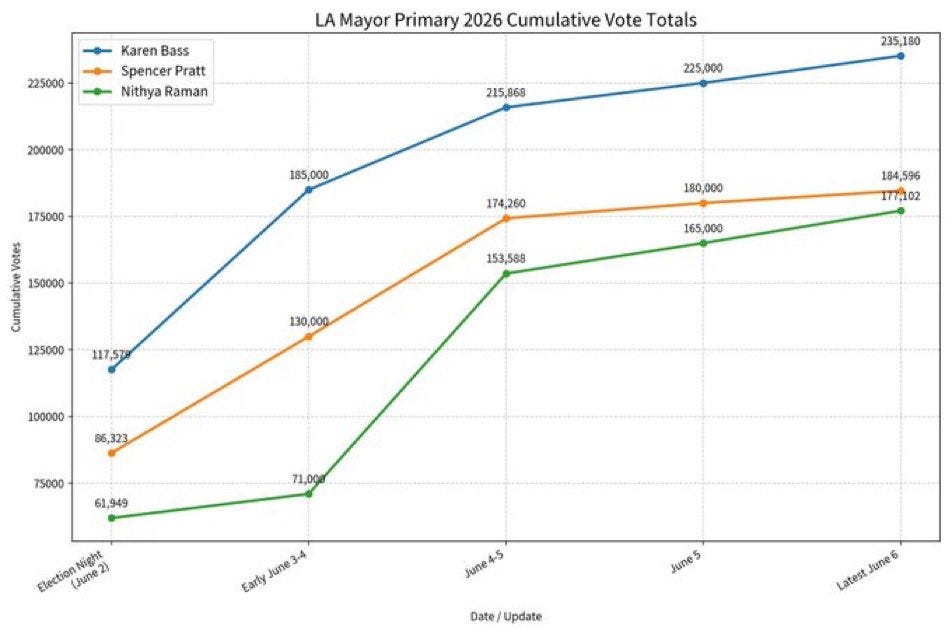
This is possible because California conducts its elections by mail, and counts any ballots that arrive up to a week after the election as long as they were postmarked by election day. This means that in any close race, it’s impossible to determine who will win on election night. Ballots can trickle in and be counted for weeks afterward1.
This slow, eventually consistent process, coupled with the fact that republicans are said to vote earlier than democrats for whatever reason, means that an election-night lead for a conservative candidate in California is often a “mirage” that will vanish in the final tally. This rubs conservatives the wrong way, for obvious reasons. It’s not only frustrating to have to wait weeks for the final result. It’s infuriating to know that even a massive election-night lead is statistically likely to evaporate days or weeks later. And it rankles for another, even simpler reason: watching this happen looks like a dirty trick. It looks like fraud.
Spare me the scolding. I’m not a J6-er and I don’t think there’s good, solid evidence that capital-F Fraud has altered the course of any federal election in my lifetime. I understand the demographic differences that cause late-cast ballots to favor liberal candidates in states that allow voting by mail. I have no particular reason to believe that cheating is taking place (other than obvious incentives). I’m just telling you what this looks like to an outside observer: it looks dirty. It looks like the dominant party in a one-party state cheating to get the outcome they want.
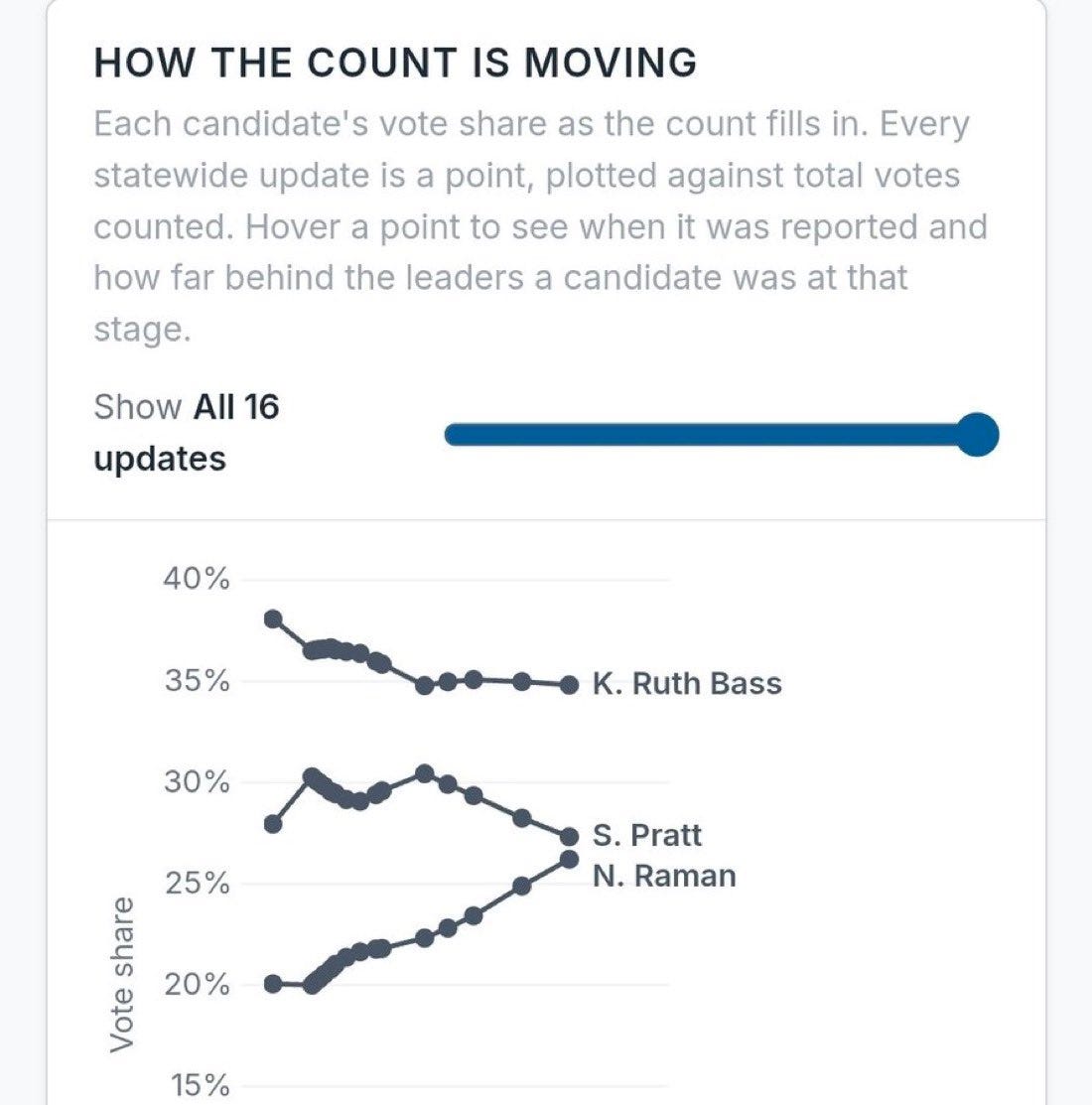
Here’s another view of the evolving vote totals in the week since the election, demonstrating Pratt’s second-place finish steadily eroding while Bass stays comfortably on top.
Here’s yet another view, this one in terms of votes added per tally update. Raman gets a huge boost a couple days after polls closed, suddenly wiping the floor with Bass.
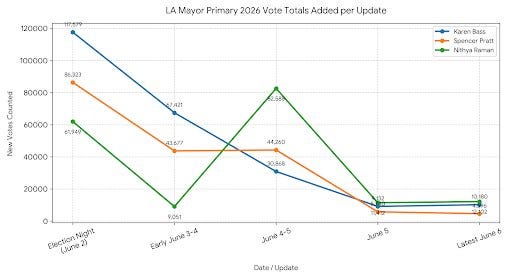
Again: this looks bad. From the outside, to an impartial observer, it’s indistinguishable from fraud. It looks like exactly what you would observe if the dominant party noted a deficit on election night, then injected just enough ballots over the following days to close that gap and come out on top, eliminating any threat of the outer party taking power in November. If you can formulate a just-so story to explain why the third-place candidate should begin massively out-performing the incumbent only in late-received ballots, congratulations and pat yourself on the back for being a rational plan-truster (Blue-team-coded). But you need to understand that your narrative is not convincing the opposition.
Twitter since the election is full of generally intelligent, typically non-conspiratorial people on the right furious with this outcome, convinced it’s brazen election fraud. They saw the pattern of vote updates above and decided the narrative of “younger progressives voted later and massively favored Raman over Bass” is nonsense. To them it looks like enemy action. And to be perfectly fair to them: how would they tell the difference?
Voting is by its nature an adversarial activity, a game played by participants who do not trust each other. The null hypothesis is that cheating will occur; it’s the job of election officials and the processes they design to prove to everyone involved that it didn’t. Elaborate procedures and customs are put in place to ensure that both sides will agree that an outcome is legitimate no matter which way it goes — things like voter identification requirements, a ballot chain of custody signed off on by both sides, and tallies conducted and communicated in the presence of observers from both sides. These procedures are necessary for the same reason that security systems and guards at jewelry stores are necessary, because the rewards for dishonest actors are too great to ignore.
Anyone passingly familiar with the history of electoral politics in the US knows that election fraud and dirty tricks were the rule rather than the exception for the entire 19th century and much of the 20th, perpetrated whenever political machines could get away with it. We know people will steal elections because they have, repeatedly, throughout history. The idea that we’ve evolved beyond the impulse to cheat at the precise moment when the stakes are the highest they’ve ever been is pure fantasy. We still regularly convict officials of election fraud, and one has to assume that the cases uncovered and successfully prosecuted are a small fraction of what actually occurs. So there is no question that elections are worth stealing, or whether people will try. The only question is whether we’ve done enough to prevent it.
In the case of California, it’s hard to escape the impression that state election laws are formulated with a reckless disregard to security, if not deliberately constructed to make dirty tricks easier. They’re one of several states where election officials must accept all ballots postmarked by election day, even if they are received afterwards (seven days in California’s case). This means counting continues at least a week after all votes have been cast, but more importantly, it means it is impossible to know how many total ballots there are when the tally begins. This in turn makes it possible in principle for unscrupulous actors to get an idea of how far behind their candidate is, then manufacture enough new ballots to take the lead. As a vector for election fraud, this exact method is as tried and true as they come, having been used to steal at least two American elections that we know of (LBJ’s Texas senate primary and Haye’s presidential election in 1876, which was so brazenly fraudulent that it nearly reignited the civil war).
But it gets even worse. By California law, ballots are still counted even when they’re missing a postmark, as long as the voter writes the date they filled it out on the envelope. This obviously enables the introduction of new ballots after the legal deadline.
(8) Vote-by-mail ballot identification envelope has no dated postmark, the postmark is illegible, and there is no date stamp for receipt from a bona fide private mail delivery service, but the voter has dated the vote-by-mail ballot identification envelope or the envelope otherwise indicates that the ballot was executed on or before Election Day and the ballot was received by the elections official in accordance with Elections Code section 3020.
But this kind of fraud remains strictly hypothetical. So far as I can tell, no one can provide proof it has happened. On the other hand, no one disputes the existence of the perfectly legal, technically-not-fraud practice of aggressive ballot harvesting. It’s a much bigger issue as it relates to a broadly shared sense of the legitimacy of the election, and featured prominently in the dialog around the disputed 2020 presidential race. Here’s how the Los Angeles DSA chapter coaches its ballot harvesters to interact with likely voters in a door-to-door sales script that would make the Avon lady blush.
Will you vote now?
Ask at least 3 times.
“X candidate is in line with all the values in our voter guide and we need your help to change this city”
“I want to make sure that your ballot doesn’t get lost in the mail or in the city bureaucracy. If we fill it out together right now, there’s an official place to sign it over to me and I can bring it to the city directly either today or first thing tomorrow morning.”
These tactics are illegal when done anywhere near a polling station — you can’t even wear buttons or apparel endorsing a candidate there, let alone tell someone who to vote for. As for “filling out a ballot together”: enjoy your jail time. But at a private residence with a mail-in ballot, suddenly this kind of pushy sales pitch, up to and including a creepy kind of facilitated voting where an activist “helps” someone fill in their ballot, is perfectly fine. A child could understand how this system could be abused to take advantage of the least capable voters, yet the practice is staunchly defended as an essential part of the franchise.
Running elections this way is a choice. As recently as 2015 California required that mail-in ballots arrived by election day to be counted, which by itself would be a big improvement to the current process. It would make it possible to return results on election night in nearly all races, and prevent the late-ballot-stuffing loophole made possible by not knowing the total ballot count when the tally begins. But instead California is moving in the opposite direction, suing the city of Huntington Beach to prevent them from requiring ID to vote in municipal elections, then passing a statewide law to prevent any other cities from requiring ID either. As an impartial observer watching California from the outside, I have to question the true goals of such legislation. There’s only one thing I’m absolutely sure of: the democratic party, who holds a trifecta in the state government, thinks these laws help them and hurt the opposition, or it wouldn’t enact them.
No, I do not personally believe that the Los Angeles mayoral race was stolen. Signature verification, while not the most robust mechanism for fraud prevention2, provides at least some check on injecting fraudulent ballots that would probably hinder large-scale efforts to change the result. And at the end of the day, two democrats on top of a three-way race in a city that went 75% for Harris just isn’t that surprising. A Pratt second-place finish would have been an upset.
But it doesn’t matter what I personally think. What matters is whether California has an election system that produces results that appear legitimate to casual observers, as opposed to one that routinely produces results that appear fraudulent to a large chunk of voters. That appearance matters, and it matters at least as much as the actual security of the system. The disappointment a partisan feels at losing fair and square, in a process he trusts, is quite different from the rage he feels when he thinks he has been cheated. The fact that this feeling is becoming more common over time is bad. It’s an ominous sign. And you can’t restore trust in such a system by browbeating dissenters.
Yes, there will always be crackpots who deny the outcome of an election that goes to the other side regardless of how airtight the process is. That’s not an excuse to abandon a good-faith effort to make the system trustworthy enough to be credible even to — especially to — your enemies. It seems to me that democrats in California have decided that they don’t need to convince their enemies, and might even find it preferable to rub their noses in it and watch them squirm.
When it comes to elections, the appearance of impropriety is impropriety. It is incumbent upon our leaders to design a process that not only is secure, but that looks secure; that not only has integrity but demonstrates that integrity so forcefully it convinces all detractors; that consistently yields results people accept as legitimate even when they lose. This is the bar for a credible election system. California is choosing to fall short of this bar, and blaming republicans for being sore losers won’t change that fact.
The final tally takes as long as it does in part because LA is contractually obligated to only employ SEIU union workers in counting ballots, and the union won’t bring in extra help during busy times (like the days after an election).
I have grave doubts that signature verification is ever enforced on any but a capricious and arbitrary basis, and it’s obviously inferior to nearly any in-person proof of identity. But it’s something.
They have signature verification in NYC elections too. Apparently they use the signature from my ID, which I did when I was 16 (15 and 1/2?) when I first got my drivers license.
My current signature looks nothing like my amateur signature from back then (I’ve practiced), so when I went to vote in a recent local election they said “Your signature doesn’t match.” I said “Oh” and they proceeded to show me the signature I was supposed to match. So I just did a loose approximation and that was good enough.
Signature approximation is probably some level of anti-fraud measure, since it adds complication, but very clearly they don’t care that much.