
My wife inhabits a corner of the internet almost entirely disjoint from my own, the woman part. I get youtube recommendations for wood working and speed runs, she sees makeup tips and fashion. Every site or app that’s even a little algorithmic shows this same basic pattern, keyed in part by our demographic data but more by our patterns of attention. This site is no exception, and she regularly sees and forwards essays to me that may as well come from another planet in terms of how far they are away from my algorithmic cluster. Sharing these gendered feeds with each other is a great source of topics for the never-ending conversation we’ve been having since the day we met.
The other day she forwarded me this essay entitled There is No Such Thing as a Casual Divorce. It’s part of an expansive genre of writing from divorced women about how free they feel after finally cutting off their good-for-nothing husbands, and why divorce is therefore ultimately something to be celebrated, despite being messy and unpleasant in the moment. This is how the author introduces her readers to her divorce and the reasons behind it. I’m not leaving anything out, this is the heart of the essay.
My husband had just completed a three-month internship in another state, during which I solo parented our three- and six-year-old children. It was exhausting, in some ways, though by then I was already used to being the primary caregiver. I already got the kids ready in the morning, handled most of their school and daycare drop-offs and pick-ups, commuted to work downtown, and orchestrated dinner and bath time.
My husband was in school, had been in school for most of the years since our first child was born, and this was how I justified taking on the extra labor.
During his internship in another state, I did miss the thorough cleaning he did after dinner, which included sweeping the entire house and wiping down all the surfaces. I did miss his body in the bed at night, and I really missed it in the morning, when I was used to sneaking out for my daily run. I did give myself multiple timeouts a day while attempting to manage the Big Emotions of young children, shutting the door to our mudroom and sitting on the steps to catch my breath.
But, I also felt weirdly at peace. There was one less person in the house with the potential to cause conflict, and in many ways, doing everything was much easier than doing almost everything and trying to delegate the rest. It was during those three months that I first learned about the term “emotional labor,” and the nagging discomfort I’d felt with the gendered disparity in caretaking duties began to tug at me more insistently.
When my husband returned from his internship, the initial excitement quickly gave way to resentment. He had a test to study for, a test he should have been studying for over the past three months but hadn’t. I found myself still more or less solo parenting, but now with another adult in the house. An adult who also demanded my care.
I didn’t start seriously thinking about divorce back then because it seemed… well, impossible. But I did occasionally fantasize about a life in which I could focus on parenting my children, and even get a break when they went to a different house to spend time with Dad. I secretly envied the divorced women I knew who had shared parenting responsibilities with their ex-husbands. They seemed so… liberated! They could do things their way! They had time to themselves! They didn’t have to take on and delegate labor under the shadow of another adult!
After reading, my first message back to my wife was: “Do these women even like their husbands?” There’s certainly no evidence in this essay that this woman does. In the entire piece, she speaks of him outside the frame of his contribution to household labor just one single time, to say she missed his body in bed at night. Where is the romance? Where is the human connection? Where is the first indication that her husband is someone whom she loves, whom she cannot live without, whom she values as a father, a lover, a friend? Am I to take this woman at her word, that she conceives of her marriage exclusively as a household management enterprise?
Of course, one assumes those missing elements are there in great or small degree. But their absence from this narrative, and from so many similar narratives that flood the zone of our contemporary marriage discourse, is revealing. If you take the great bulk of dissatisfied wives at their word, their sole complaint with their husband is that he doesn’t help out enough around the house. Not he cheats on me; rather, I need to tell him to load the dishwasher. Not he beats me; rather, I always do the school pickups. Not he is cruel or neglectful; rather, I always have to cook dinner.
Is this really the state of modern marriage? I don’t think it is, but you could be forgiven for thinking so if you pay attention to the deluge of gender equity think-pieces and divorce apologia we’re all subjected to from every quarter. The happy wives aren’t writing essays (or aren’t being published).
But the happy wives are still doing more work around the house than their husbands.
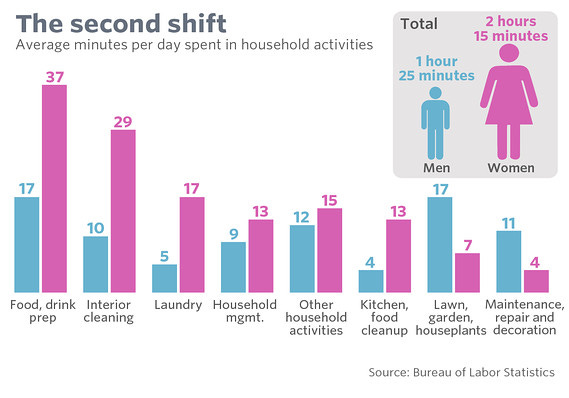
Arlie Hochschild popularized the term “the second shift” with her 1989 book of the same name, the first to widely publicize the household labor gender gap with quantifiable data like the above chart.
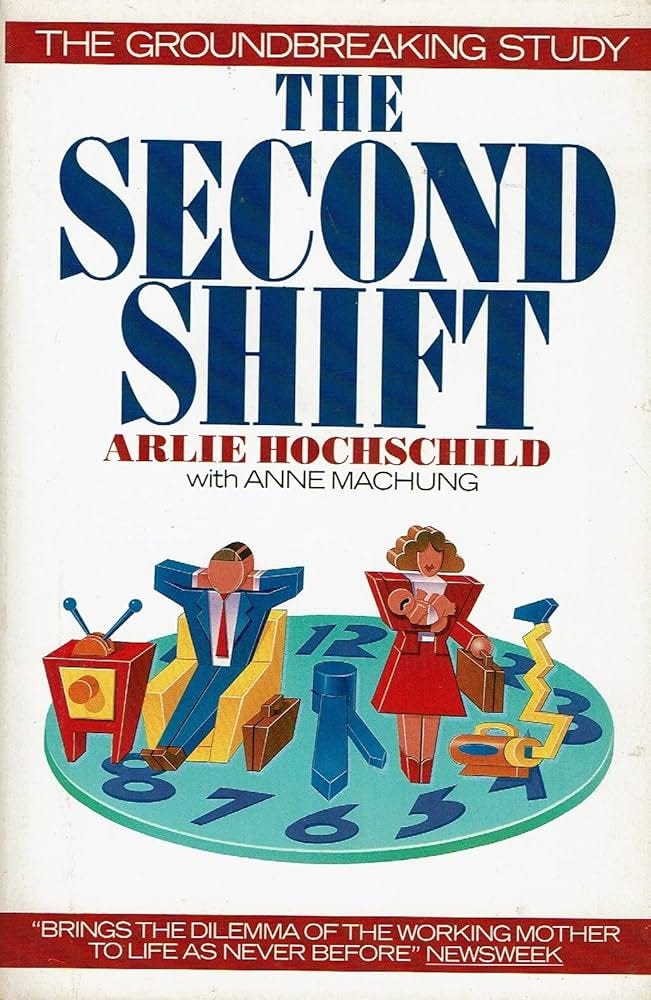
The phrase has haunted the marriage discourse ever since, with women vowing to not be taken advantage of by a husband unwilling to help out after he gets home from the office (it’s always an office in popular conception, the working class and their household arrangements being beneath mention). And most men, at least men of the office-going class, take this problem seriously as well.
