The personal is totalitarian
Nowhere and nothing is neutral
One of my kids came home from school the other day irritated by one of their peers. One of the more popular 4th grade boys was holding court on the playground, ranting to an audience of orbiters on topics including the Super Bowl contestants (he’s a Patriots fan and thinks the Seahawks are “trash”) and, of course, Trump. This 9-year-old boy had a surprisingly fully-formed opinion of our 47th President which he no doubt arrived at on his own after a thorough examination of the facts, unaided by his parents or the news media. You can imagine what those opinions are, and I’ll dedicate as much space to them here as they’re worth.
Our kids have in the past asked us what to do when their schoolmates bring up Trump or other political topics, because they don’t know what to say. Our advice is simple: tell them politics is boring and change the subject. Did you try that this time? we asked. Yes, but it didn’t work — his friends were enjoying the trash talk as much as he was, all of them reveling in that oldest of schoolyard pursuits: ganging up on a shared enemy. Our kids were the weird ones for feeling uncomfortable about the intrusion of boring grownup stuff into recess.
Fifteen years ago I would have said that it should be uncontroversial that a nine-year-old child shouldn’t have an opinion on national politics, and that we shouldn’t care what it was if he did. But the world has very clearly moved on. The kids think it’s normal to talk this way because they hear mom and dad do so constantly. They have the same opinions their parents do, as is only right and natural, but unlike in the possibly-imaginary rosy recent past, there’s less protective urge on the part of parents to shelter kids from this rancorous and unsavory aspect of the adult world, to guard their innocence, to let them be kids while they can. On the contrary, children’s involvement in political activism has been progressively normalized by every important institution in their lives, from the shows they stream on Netflix to the social media their parents consume to the lesson plans in their schools. It’s in the air and water.
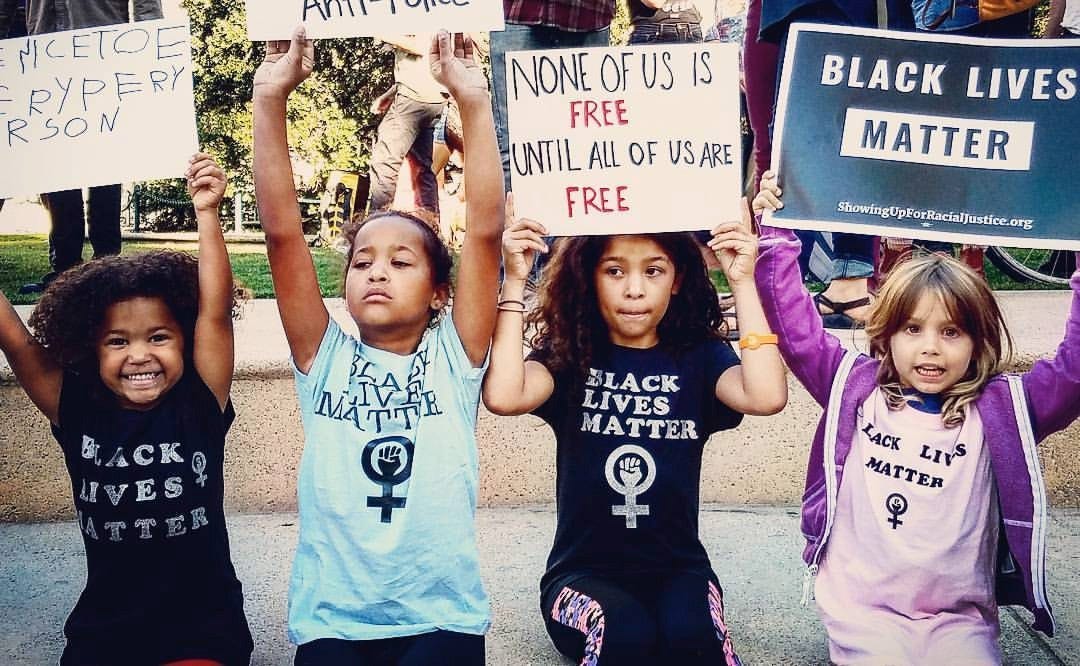
The current trend of soccer moms taking their small children to violent protests to be tear-gassed live on TikTok is the logical endpoint of a tradition of protest stretching back to the sixties. But more particularly, it’s part of of a more recent wave of totalizing ideology that rejects the very idea of separate personal and political spheres, considers the exclusion of any aspect of one’s life from one’s political commitments to be a grave sin, a sign of privilege that must be expunged and atoned for with ever greater commitment to the right causes. A worthy adherent to the omnicause is not permitted to cordon off sensitive areas of her life, such as her hobbies or her children’s innocence, away from the movement. It is the perfect distillation of the totalitarian impulse summarized by Mussolini, applied to one’s own life: “Everything within the state, nothing outside the state, nothing against the state.”
But rather than to a formal state with legible leadership and principles one must obey, today’s willing totalitarians pledge allegiance to a constantly shifting web of positions that are no sooner stated than agreed upon and enforced by the mob. No authority publishes new edicts after party deliberation; rather, consensus appears to materialize or emerge from social media fully formed like Athena springing from the mind of Zeus, slogans and placards ready to go. The mob is more effective at enforcing conformity of opinion than the wildest fever dream of a secret police force, and yet there is no one to appeal to when you place a foot wrong and bring down their wrath. In the common case this simply means the loss of social status among one’s peers, but it can get much worse. Its most rabid enforcers commit violence, end careers, and destroy lives as casually and automatically as they set fires and build barricades. And what they demand, more than anything else, is the continual expansion of their ideology into virgin territory yet unclaimed.
Billie Eilish’s cringe assertion of no one being illegal on stolen land continues a long-standing tradition of actors and artists bringing politics into award show speeches that conservatives have been complaining about for decades to absolutely no avail. But what I found striking about Eilish’s self-important pronouncement was the extent to which I expected it as a matter of course, not just from puffed-up award winners at a podium, but from anyone with any platform, no matter how small. It’s hard to call her speech an intrusion of politics into a neutral space, not only because that space hasn’t been neutral for decades, but because there are so very few neutral spaces left, anywhere.
Why does my favorite DJ on satellite radio feel the urge to dedicate an hour of drive-time radio to the brave resistance in Minnesota? Why does my local pet store think it’s necessary to inform me how they feel about marriage equality? Why does the neighborhood preschool co-op make parent volunteers sign a pledge that they won’t let ICE agents into the building for any reason? (The neighborhood and preschool are 95% white and 0% illegal alien). For that matter, why did so many of my neighbors feel compelled to place large rainbow-colored signs in their yards informing passersby what, in that house, those resident believe?
Everywhere I turn, I find zealots planting some new flag proclaiming another part of my life, previously permitted to go about its business with its head down, contested territory. They are claiming it for their own, making it known what kind of people should feel welcome there and who should feel free to get lost. Businesses I frequent, sports I enjoy, games I play, publications I read, shows I watch, clubs I belong to, my kids’ playground gossip — nothing is off limits. It’s a constantly rising tide of ideological commitment, always to some new, most-important-ever thing, but always advancing, and always in one direction.
I should be used to it by now, but I’m not. I notice it constantly, and the fewer neutral spaces that remain unclaimed, the more distressed it makes me. I can’t help but feel I’m witnessing conquest by some new invasive form of life — that these aren’t people with ideas, but rather ideas with people. Whatever it is, it’s wildly successful and shows no signs of stopping. And it doesn’t seem to like me or my kids very much.
There’s a guy I watch on YouTube whose schtick is to take expensive new electronic devices like phones and tablets and meticulously tear them apart in a demonstration of their “durability” but obviously just relishing in the pure animal joy of bending an iPhone until it snaps in half. YouTube knows I watch his stuff, so it showed me this recent short of his where he details why he got rid of his Tesla to spite Elon, whom he considers a Nazi.
I just wanted to watch you scratch phone screens until they break. What is this? On an intellectual level, I understand why a guy who makes his living carving smart phones up for ad revenue would make a video like this. He’s a sincere believer, he’s achieved some success that grants him a large platform, and he considers it his duty to inform the world of his convictions so that they spread to others. That’s exactly what makes this memeplex so successful.
But if it’s fair play on his part to evangelize, it’s fair play on mine to be pissy about it. I just want to be left alone once in a while, to enjoy my nerdy hobbies in peace. I want for there to remain some spaces in the digital and physical realms where I can escape the constant din and howl of our Troubles when the mood strikes me. Acolytes of the omnicause are determined to deny me any such respite, which is why they are winning. So far, anyway.
For my part, I was fortunate to be raised in a cooler America, when heated political discussions around the dinner table didn’t kick off in earnest until one’s late teen years, not in grade school. Presumably the adults in my life had political opinions, but they kept them to themselves — at least around the kids, which was considered a matter of essential propriety. If any of my peers cared at all about the national political scene, they sure didn’t tell me about it. We didn’t talk about it, ever — we had better things to do. And while it pains me that my kids’ generation apparently feels differently, it pains me at least as much that my own generation grew up to be so ideologically expulsive, so unable to keep it in our pants when political topics come up.
Our collective lack of restraint, our loose decorum, our tendency to infuse every aspect of our lives with ideology, is unbecoming. It makes us all miserable. I know exactly where the kids are getting it, and I’m not happy with us about it.


