
Winners and Losers by Sidney J. Harris is a collection of short, pithy aphorisms about what it means to be a good person and to live a good life. The book is out of print and Harris is long dead, so as a fan of his work I’ll be uploading a few scanned pages every Sunday until I run out. Harris and his publisher retain all copyright.
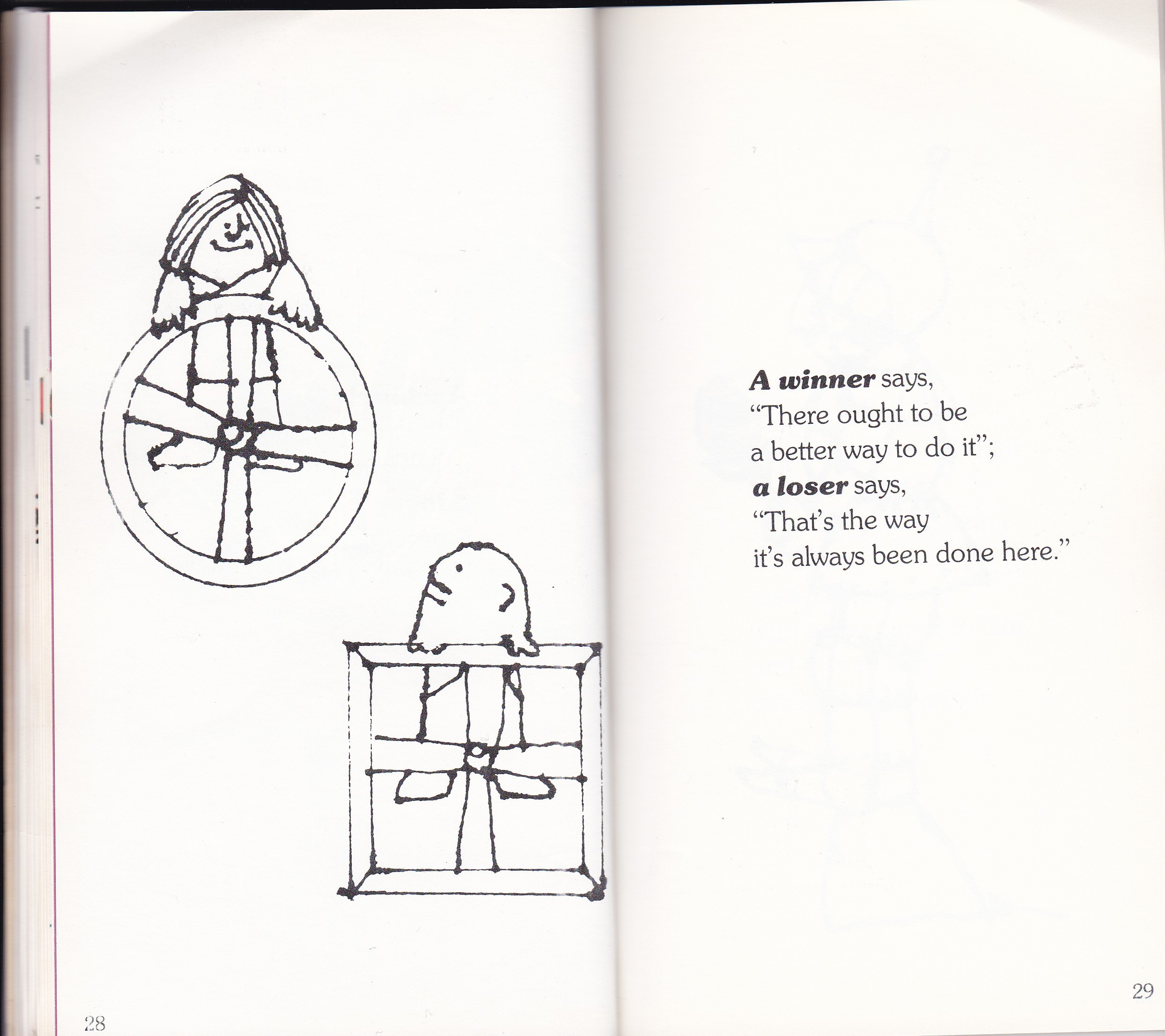
A winner says, “There ought to be a better way to do it;
a loser says, “That’s the way it’s always been done here.”
This closely echoes the moral in an earlier saying:
A winner says, “Let’s find out”;
a loser says, “Nobody knows.”
You see this theme about the value of intellectual curiosity, about being willing to take risks by reexamining old assumptions and tampering with something that’s working well enough. Unlike many of the messages in this book, it’s fundamentally progressive in its outlook — it insists that a better world actually is possible, if only we’re willing try for it.
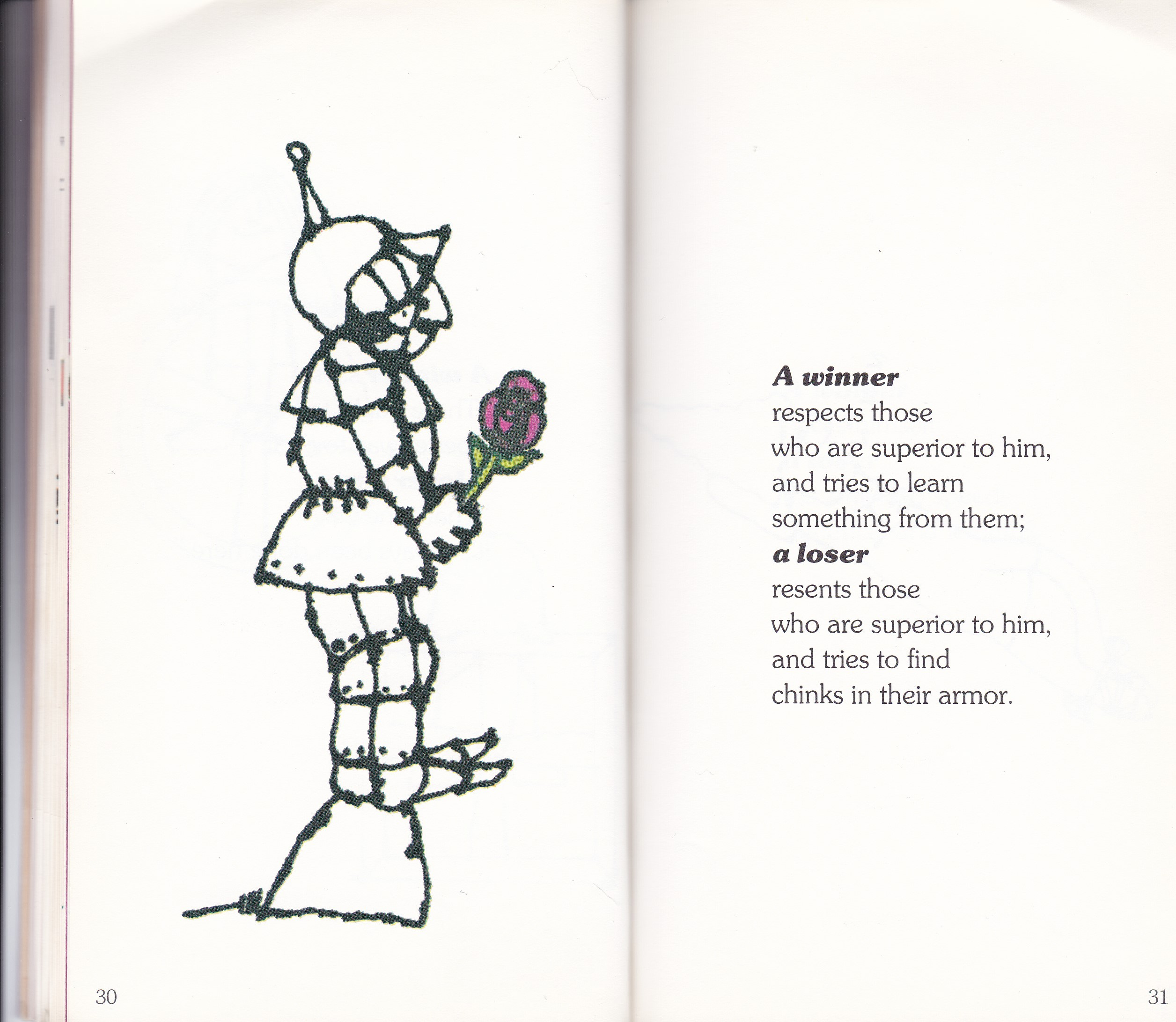
A winner respects those who are superior to him, and tries to learn something from them;
A loser resents those who are superior to him, and tries to find chinks in their armor.
On the other hand, Harris’s obvious respect for natural hierarchy is unavoidably conservative and shines through in many of the sayings, especially in this one. There’s an uneasy tension between Harris’s insistence that anyone can better themselves through the conscious adoption of better principles and practices, and his clear belief that there are in fact natural winners and losers, that some people are simply better than others. Here he tries to square the circle: hierarchy might be natural and inevitable, but that doesn’t mean one can’t improve their relative station by emulating their betters.
Early in life I found this lesson hard to learn and hard to apply. At school there was no one superior, even among the faculty — at least, in the single metric (intelligence) I had internalized was the only one that really mattered. Other kids were more athletic or more popular than me, but it never occurred to me they might be worth emulating in any way, their social or sexual success easy to rationalize as inconsequential compare to my intellectual ability. But then in college, and especially later still in elite tech, I finally encountered true peers who could best me in any domain you might care to name, including my prized intelligence. It took me a long time to recontextualize my own place in the hierarchy, and to develop a new understanding of myself as a person with superiors. It was hard, and painful, but I think I managed it well and came out the other side a better person for it. Over the. years I’ve been fortunate to know many exceptionally intelligent and virtuous people, and I’ve rarely caught myself resenting their greater success.
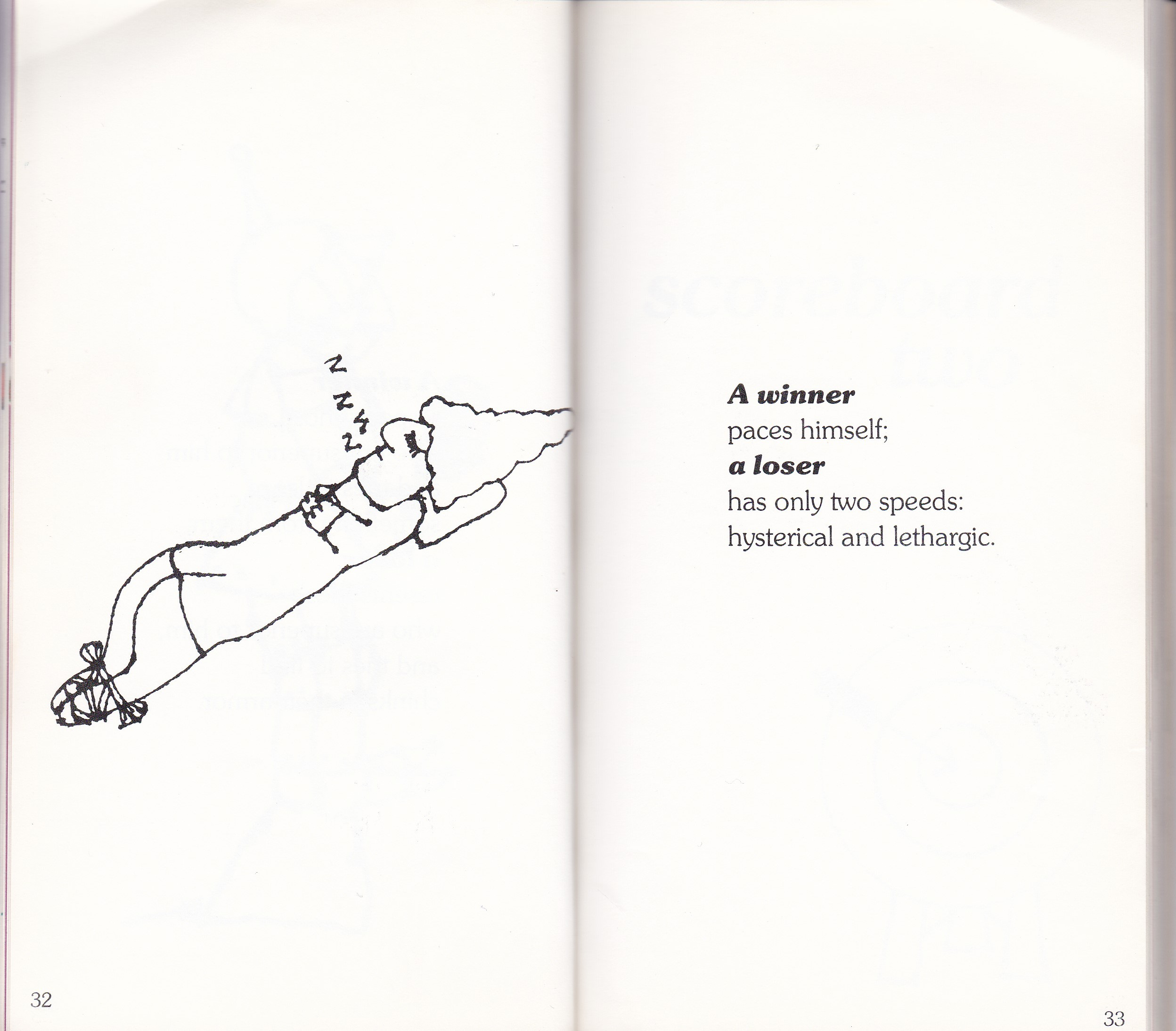
A winner paces himself;
a loser has only two speeds: hysterical and lethargic.
As we’ve discussed in the past, I dick around. But in the main, I don’t consider dicking around to be an act of lethargy. Instead it often seems like my wandering attention gets the best part of me, my most essential energy, leaving the lethargy for the boring but important work I need to attend to. No, I don’t have ADHD, I’ve taken tests. And in any case I think it’s pretty silly for someone who graduated college with honors and spends all day at a desk doing detail-oriented computer work to claim they have an inability to focus that rises to the level of disability. Rather, I think Harris here is capturing an essential human struggle familiar to anyone who has ever postponed the necessary, which is to say nearly everyone. The reason so many of these sayings are compelling to me, years later, is that I don’t clearly and instantly empathize with the winner — I can see the loser in myself, understand it as a set of bad habits to be overcome through practice and effort.
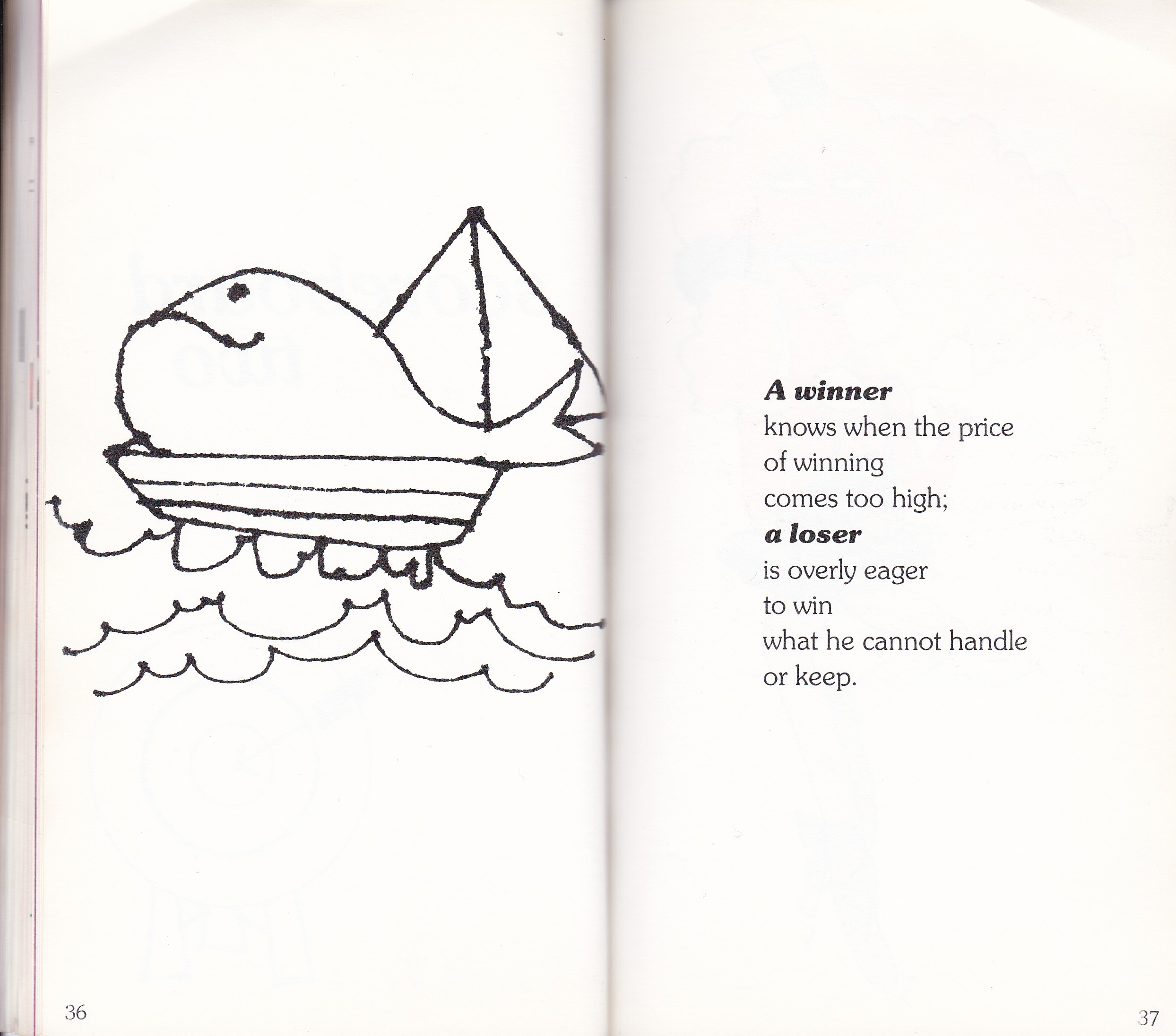
A winner knows when the price of winning comes too high;
a loser is overly eager to win what he cannot handle or keep.
Again we see echoes of an earlier aphorism:
A winner knows what to fight for, and what to compromise on;
a loser compromises on what he shouldn’t, and fights for what isn’t worthwhile fighting about.
This is a theme that clearly weighs heavily on Harris, choosing one’s battles with wisdom and forbearance. He communicates the same moral over and over with different words and emphases, as we’ll see as the series continues.
Attentive readers will notice I’ve elided pages 34 and 35. This is because the book is divided into chapters Harris calls “Scorecards”, and we’ve now entered the beginning of Scorecard Two.
That’s all for this week. See you next Sunday.
I used to associate this style of cartoons with Boomers, because I know it was popular in the 1960s -- could even be compared to the Trump-Epstein "birthday doodle" in style. But Sydney was born in 1917, which I guess makes him the Greatest Generation. Inspiring stuff.